Monday, March 16, 2015

Disability Rights


I first started thinking about the issue of disability rights when I moved from the United States to Canada. The U.S has something called the American Disabilities Act which, among other things, requires that all buildings be accessible to individuals with disabilities. I was surprised to discover that Canada doesn't have an equivalent. For instance, only a few of the subway stations in Toronto have elevators and are wheel-chair accessible. My sister, who has a knee injury, also made an appointment to see a physical therapist. When she arrived she discovered that there was a large flight of stairs leading to the office. There was no elevator or escalator in the building. She was able to climb the stairs very slowly, but now imagine someone in a wheel chair facing the same situation. They simply wouldn't be able to get up the stairs to see the therapist. Issues of accessibility severely limits where a disabled person can go. Acceptability, however, is just one of the issues that the 1 billion people around the world with disabilities face. Here is a list of some of the other issues found across the world:
  • Children with disabilities are often denied the right to be included in the general school system.
  • Individuals with mental disabilities are often denied the right to vote, seek employment, marry, or make other decisions that effect their own lives.
  • Individuals with mental disabilities are also often forced to live in psychiatric institutions. These institutions abuse patients as well as force them to live in unsanitary conditions and deny them proper medical treatment. 
  • Women with disabilities face higher rates of sexual and physical violence. 
For more information visit:

Saturday, February 21, 2015

Book Review: Half the Sky


I recently finished reading the book Half the Sky by Nicholas D. Kristof and Sheryl WuDunn. The book tackles many issues relating to the oppression of women around the world including slavery, education, and maternal mortality. Kristof and WuDunn effectively present information in a blend factual data and true stories to create a powerful and moving book. They also provide advice on what we all can do to improve the status of women around the world. Here's a few of their suggestions:

  1. Donate to a grassroots project benefiting women through www.globalgiving.org or support microlending for women entrepreneurs through www.kiva.org. Microlending is an effective way to raise the status of women because it allows them to start their own businesses and thus increases their value to their community and family.
  2. "Sponsor a girl or woman through Plan International, Women for Women International, World Vision, or American Jewish World Service" (Kristof and Wudunn). These organizations use your monthly donation to support an individual in need. 
  3. Subscribe to www.womensnews.org or www.worldpulse.com to get email updates about issues relating to women's rights.
  4. Join the Care Action Network to advocate for women's rights. Members learn and can communicate with their legislators about issues effecting women around the globe.
You can also visit http://www.halftheskymovement.org/ to learn more. 

Saturday, October 11, 2014

Nobel Peace Prize 2014

The 2014 Nobel Peace Prize was awarded to Malala Yousafzai and Kailash Satyarthi. Malala is a child's rights activist who advocates for education despite having been shot by the Taliban in 2012. She is the youngest person to ever receive a Nobel Peace Prize.

Kailash is also a child's rights activist. He has worked to end child labor and ensure that all children have the opportunity to go to school. There is an estimated 168 million children working as child laborers around the world. These children are often forced to work in hazardous conditions like mines and factories, as well as with harmful substances such as chemicals and pesticides. This is not only detrimental to their health, but it also prevents them from receiving an education.

For more information on the 2014 Nobel Peace Prize read this article by Human Rights Watch:
http://www.hrw.org/news/2014/10/10/nobel-peace-prize-victory-education

For more information on Malala and her work visit: http://www.malala.org/

For more information of Kailash and his work visit: http://www.globalmarch.org/aboutus/kailash-satyarthi

Friday, August 15, 2014

International Humanitarian Law and the Gaza Crisis

There has been a lot of talk about violations of international humanitarian law with the conflicts in Gaza and the Ukraine. International humanitarian law or the laws of war are a set of treaties meant to protect the human rights of civilians and other non-participants of the conflict in wartime. Non-participants can include injured soldiers, prisoners of war, and medical workers. The backbone of international humanitarian law is the four Geneva Conventions. Here are some of the key points:
  • The humane treatment of all non-participants in the conflict. This means no torture or murder and the right to medical treatment.
  • All parties in the conflict must distinguish between civilians and military forces.
  • Medical personnel and equipment receive special protection. Which means that military forces should not harm medical personnel, equipment, or hospitals.
  • No collective punishment

In my last post I talked about violations of the laws of war in the Ukraine, so in this post I will focus on the Gaza Crisis. Both Israel and Hamas have violated international humanitarian law during the fighting . Article 3 in the fourth Geneva Convention, states in reference to, “Persons taking no active part in the hostilities” that “the following acts are and shall be prohibited...violence to life and person…” Israel’s airstrikes on populated areas of Gaza are a violation of this. Israel uses airstrikes to destroy Hamas missile caches which are often hidden in populated areas. Be this as it may, article 33 specifically says that, “No protected person may be punished for an offense he or she has not personally committed.” When Israel bombs an area populated by civilians, although it gives preemptive warnings before the airstrike, they are still punishing those who did not place the missiles there. Hamas is also guilty of violating these two articles of the Convention. They have sent missiles into Israel that injured or killed civilians and damaged civilian property. In addition, they also violated article 28 of the Fourth Convention which states that, “The presence of a protected person may not be used to render certain points or areas immune to military operations.” Hamas has done this on numerous occasions by storing missiles under apartments, U.N schools, and mosques, as well as telling its civilians to stay in their homes when Israel warns them to evacuate before an airstrike. By using Palestinians as human shields, Hamas has made it so that the Israeli army cannot reach its objectives without harming civilians.

Violations of international humanitarian law go unpunished more often than not as there is no reliable means of enforcing them. War crimes are tried by the International Criminal Court. The court can only try cases, however, if the state in question has signed the Rome Statute (the treaty that established the ICC), if the state submits to the authority of the ICC, or if the UN Security Council moves to have the ICC try the case. This system leaves too much room for error. This does not mean that we should ignore the Geneva Conventions. Even though they will never prevent wars from occurring, they still give us an ideal to strive for.

For more Information on the laws of war and the Gaza Crisis read this article by Human Rights 
Watch: http://www.hrw.org/news/2014/08/03/qa-2014-hostilities-between-israel-and-hamas

For more information on the Geneva Conventions explore the International Committee for the Red Cross' website: http://www.icrc.org/eng/

Thursday, August 7, 2014

Conflict in the Ukraine and the Laws of War

The conflict in the Ukraine began with Russia annexing Crimea. Ever since there has been fighting between pro and anti Russian groups. Recently, Human Rights Watch reported that insurgent groups have not only used ambulances to transport uninjured fighters, but have also destroyed medical equipment and supplies, threatened medical staff, and endangered civilian patients.  All these actions are clear violations of the laws of war set forth by Article 19 in the first Geneva Convention. The Article states that, "Fixed establishments and mobile medical units of the medical service may in no circumstances be attacked...should they fall into the hands of the adverse party, their personnel shall be free to pursue their duties." By disregarding the Geneva Convention, insurgent fighters are endangering the human rights of civilians and other vulnerable parties.

For more information read this article by Human Rights Watch: http://www.hrw.org/news/2014/08/05/ukraine-insurgents-disrupt-medical-services

Monday, July 28, 2014

U.S Immigration Crisis

The debate over illegal immigration was once again brought to national attention by the recent influx of children illegally crossing into the United States from Central America. Illegal immigration in the U.S and elsewhere has long been the cause of much discussion. Those in favor of it state that illegal immigrants help the economy by providing cheap labor. Others attack it, claiming immigrants steal jobs away from actual citizens. The economical effects, however, should not take away from what these immigrants suffer through in the hopes of finding a better life. Many leave their home country to escape violence or poverty. The journey to the U.S itself is often very dangerous. Some are smuggled in by trucks, shipping containers, or make the journey on foot through the Arizona desert. The latter method often results in the migrant dying of dehydration. If they do make it to the U.S, they are vulnerable to an array of abuses including poor pay and living conditions. They must also live with the fear of being detained and deported. Now imagine a child, unaccompanied by an adult, going through all this.

Last Friday, President Obama met with presidents from El Salvador, Honduras, and Guatemala to discuss a solution. In addition, President Obama wants congress to dedicate nearly 4 billion dollars to the immigration problem.The 2008 Trafficking Victims Protection Reauthorization Act is currently slowing down the deportation process. The act requires that each child be given a court hearing to determine whether or not they will be allowed to remain in the U.S. Due to a back log of cases, this can take years. Obama therefore wants the money to go towards improving the border patrol and detention facilities, as well as increasing the amount of judges trying these cases. In a press release, Amnesty International reminded leaders of the four countries that they have an obligation to protect the human rights of migrant children.

For more information on how U.S immigration policies effect migrants see: "Torn Apart", a multimedia feature created by Human Rights Watch in partnership with artist Platon.

For more information on the recent immigration crisis read this article by NPR: http://www.npr.org/2014/07/09/329848538/whats-causing-the-latest-immigration-crisis-a-brief-explainer

For more information on illegal immigration read this article by the United Nations Office on Drugs and Crime: http://www.unodc.org/toc/en/crimes/migrant-smuggling.html

Monday, July 14, 2014

Israeli Palestinian Conflict

The Israeli Palestinian Conflict began with the formation of Israel. After World War II, the United Nations divided the region into an Arab and a Jewish state. Both sides refused to recognize each other as legitimate states and have been fighting intermittently ever since. The conflict recently escalated when three Israeli teens were abducted in the West Bank and murdered. Israel blames Hamas, a terrorist organization who controls the Palestinian territories, for their deaths. Israeli troops were sent into Gaza to arrest the suspected murderers. Hamas has been using this, along with the death of a Palestinian teen who was murdered in retribution by an orthodox Jewish extremist group, as an excuse to launch long range missiles into Israel. In turn, Israel has been launching airstrikes into Gaza to destroy Hamas missile cashes. Casualties on the Israeli side have been limited due to their Iron Dome defense system. Civilians of Gaza, however, have not been so lucky. This is further complicated by Hamas asking Palestinians not to evacuate despite Israeli warnings that there will be an airstrike.

For more information about the history of the Israel Palestine Conflict read this article by Global Issues:
http://www.globalissues.org/article/119/the-middle-east-conflict-a-brief-background

For more information on the recent escalation of the conflict read this article by NPR:
http://www.npr.org/blogs/thetwo-way/2014/07/14/331321398/israel-shoots-down-drone-as-clash-with-hamas-continues

Thursday, July 3, 2014

The World Bank and Human Rights

The World Bank is an organization that gives loans and advice to developing countries. Their stated goal is to reduce world poverty. They have, however, been inadvertently funding human rights abuses. In Honduras, they funded a project that led to violence and killings. While in some cases they have fought against discrimination in the developing world, in others they seem to ignore it. The World Bank delayed funding to countries like Uganda after anti-gay laws were passed, but continued to give loans to Burma where the government discriminates against the Rohingya, a minority Muslim group. The bank has a huge influence over the developing world, and they should use that influence and do their due diligence to ensure that there are fewer human rights violations.

For more information read this article by Human Rights Watch:
http://www.hrw.org/news/2014/07/01/world-bank-falling-short-rights

Wednesday, June 18, 2014

Freedom of Expression

Lack of freedom of expression is one of the biggest violation of human rights worldwide. Every human being has the right to express their beliefs and thoughts; yet in most of the world this right is constantly denied. Governments, hoping to suppress dissent, imprison, torture, and murder individuals who speak out against them. 

For more information on freedom of expression read this article by Amnesty International: http://www.amnesty.org/en/freedom-of-expression

Saturday, May 24, 2014

Coup in Thailand

On May 22 a military coup was announced in Thailand. The new military government has committed numerous human rights abuses including arresting supporters of the previous government, censoring media, and enforcing a curfew.

For more information read this article by Human Rights Watch: http://www.hrw.org/news/2014/05/24/thailand-rights-free-fall-after-coup

Monday, April 28, 2014

Child Marriage

Child marriage is a world-wide problem. It affects both boys and girls, although it more commonly impacts the later. In many developing countries parents will marry off their daughters (or sons) before they are 18 years of age. In some cases this is because of traditional gender roles or poverty. In most developing countries women are seen as less valuable than men and a burden that should be discarded with as soon as possible. By marrying off their children early, families can also reduce their expenses. No matter the reason, the result is the same. Child brides are often subject to sexual assault and are more susceptible to having complications during childbirth. They also typically do not receive an education; this in turn contributes to trapping them in this horrible situation. 

Currently Yemen is considering passing a law to end child marriage in their country.

For more information on child marriage visit these websites:
For More information on child marriage in Yemen read this article by Human Rights Watch:

Sunday, April 13, 2014

Somalis In Kenya

Kenya has been detaining and deporting Somalis in the country who do not have proper identification papers as part of an anti-terrorism measure. The Kenyan government, however, makes it nearly impossible for the Somalis to get identification papers. Many of Somalis are in the country as refugees seeking asylum.

For more information read this article by amnesty international: http://www.amnestyusa.org/news/news-item/kenya-somalis-trapped-in-%E2%80%98catch-22-amid-crackdown-on-refugees

Sunday, March 16, 2014

Russia's Crackdown on Free Media

Russia has initiated a crackdown on free media. This includes blocking websites, television stations, and print media. These new measures taken by the Russian government are meant to silence dissent relating to the referendum that was held in Crimea. Crimea voted today to secede from the Ukraine and become a part of Russia.

For more information read this article by Amnesty International: http://www.amnestyusa.org/news/news-item/russia-media-black-out-ahead-of-disputed-crimea-referendum

Thursday, February 20, 2014

Education

It is common in the U.S. for children to complain about having to go to school, but millions of children around the world are unable to receive an education. Yet without an education many of them become trapped in a web of poverty. Young girls are especially affected. Many countries that allow boys to go to school refuse to educate girls. When denied schooling, however, they become vulnerable and dependent on men. In countries like India, Thailand, and Cambodia they are sold into sex trafficking. Even when given a choice, many cannot earn a living elsewhere without an education.

Those who try to affirm their right to education are often brutally punished. Malala Yousafzai stood up for girl's education in Pakistan and was shot by the Taliban as a result. She survived her ordeal and continues to speak out in favor of education for all children. For more information I highly recommend reading her book I Am Malala.

Schooling is at the heart of many poverty centered issues. When people are educated they not only can get better jobs, but are also less likely to be manipulated.

To support this cause you can donate to the Malala Fund.

Sunday, February 9, 2014

Sochi Winter Olympics

With the commencement of the 2014 Winter Olympics, Russia has been arresting civil society activists for protesting environmental violations that occurred during the building of the Olympic stadium. They are arrested on trumped up charges like "petty hooliganism."

For more information read these articles from amnesty international:

Monday, January 13, 2014

The Rohingya Boat Children


The Rohingya are a minority Muslim group from Burma. They have been migrating to Thailand, often in small boats since Burma continues to deny them citizenship. Once in Thailand, however, many of them end up in trafficking camps and are then sold into slavery. The Thai government is doing nothing to protect them. Many of the migrants are children.

To find out more visit: http://www.hrw.org/news/2014/01/06/thailand-protect-rohingya-boat-children

Saturday, December 7, 2013

Child Soldiers

A child soldier is defined as a person under the age of 18 either forcibly or willingly participating in armed conflicts. Some children are abducted and forced to join military groups, while others volunteer in order to have a sense of stability and protection in a war-torn region. While many are used in combat roles, others occupy support positions such as porters, messengers, or in the case of girls, sex slaves. Regardless of their role in these military groups, children often witness and are forced to do horrible things to survive. Accounts from former child soldiers describe a brutal kill or be killed mentality.

According to War Child UK there is an estimated 250,000 child soldiers worldwide. These children are invariably  located in unstable regions. Amnesty International recently reported that child soldiers are involved in the conflict in the Central African Republic (For more information on this conflict see my last post).

The issue of child soldiers is not an easy one to solve. Many organizations including the United Nations negotiate their release from military groups, but this is not a sustainable solution. More children will take the places of those freed as long as there is conflict within the region in question. Other organizations like War Child and the International Rescue Committee rehabilitate and provide support for former child soldiers. Their work is invaluable. They give these children a chance to have a better life. The problem, however, persists. I believe that the issue of child soldiers can only truly be solved with peace and stability. These things, however, are slow to come. Until they do, we must do what we can to help because no child deserves to suffer or participate in the horrors of war.

For more information visit: http://childrenandarmedconflict.un.org/effects-of-conflict/six-grave-violations/child-soldiers/

To help visit: http://www.warchild.org/

Sunday, November 10, 2013

Conflict in the Central African Republic

In early September a group of armed Christians attacked an Islamic neighborhood, burning homes and killing several people. In retaliation, a coalition of armed Islamic groups called the Seleka attacked a Christian community. The conflict has continued to escalate. Many civilians have been displaced within the country or have been forced to take refuge in neighboring nations.

For more information read this article: http://www.amnesty.org/en/news/new-satellite-images-reveal-shocking-aftermath-abuses-central-african-republic-2013-11-08

Saturday, November 2, 2013

Syrian Refugee Crisis

In 2011 protests against Syrian President Bashar al-Assad's regime were put down violently. Soon afterwards the country erupted into civil war. The violence created by fighting between the government and the Free Syrian Army has forced millions of people to seek refuge in neighboring countries like Turkey, Lebanon, Egypt, Jordan, and Iraq. The influx of refugees, however, has stretched the resources of these countries and prompted them to start turning people away. This has left many Syrians trapped between the borders of Syria and its neighboring countries. For those that are lucky enough to make it past the border, refugee camp conditions are far from ideal. Often times there is not enough clean water or medical supplies.

For more information about the Syrian Civil War visit http://www.cbc.ca/news2/interactives/syria-dashboard/

For more information about the Syrian Refugee Crisis visit http://www.amnestyusa.org/news/press-releases/syrians-fleeing-violence-are-turned-back-at-jordanian-border

Saturday, October 26, 2013

Saudi Arabia Women Driving Movement

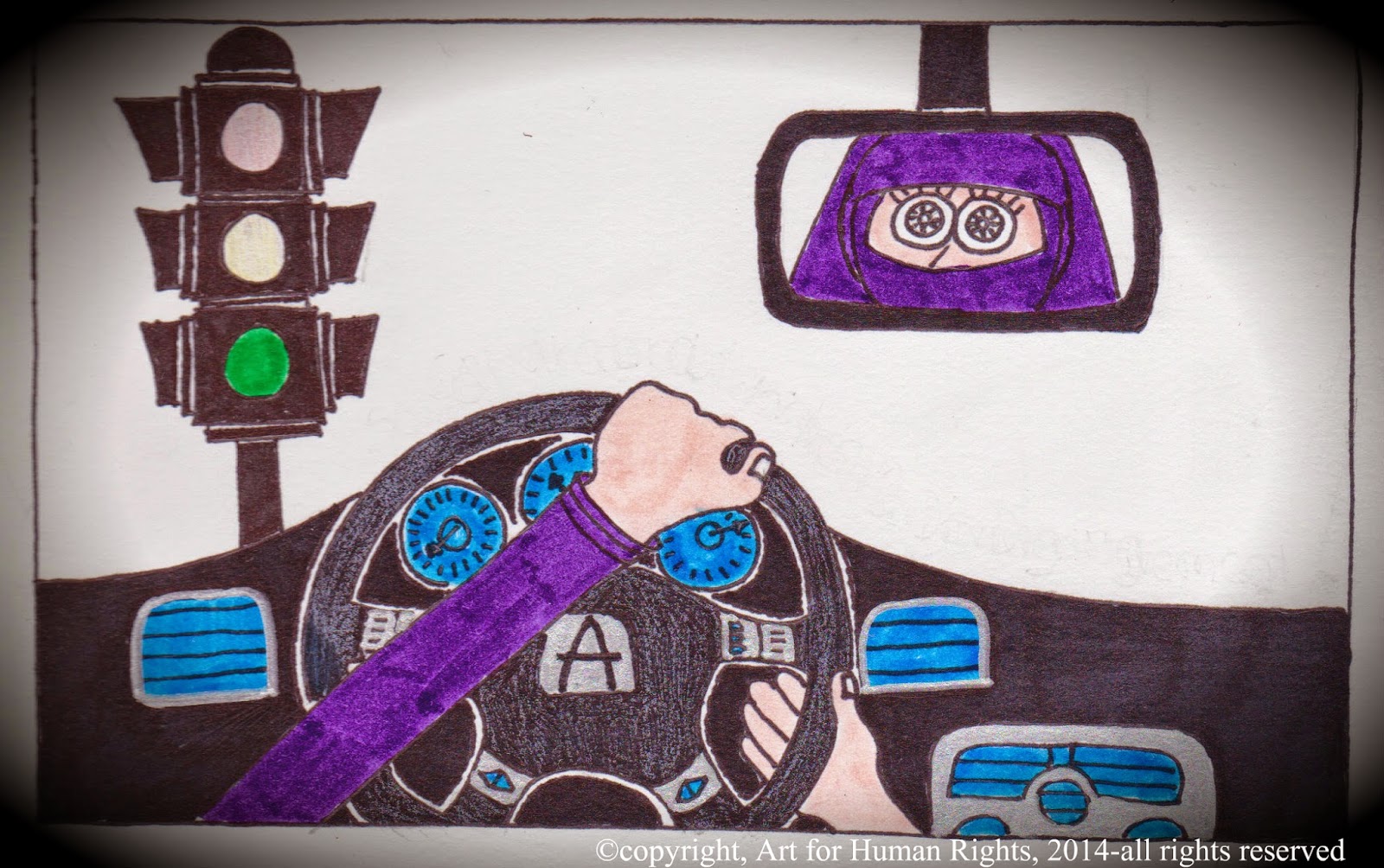
In Saudi Arabia women are not allowed to drive. This infringes on their human rights by violating the right to equality and freedom of movement. Religious doctrines in the country are interpreted to prevent women from driving but there is no official law enforcing the ban. An online campaign was started to protest the ban on women driving. The campaign asked women to get behind the wheel. As part of the protest several women filmed themselves driving and uploaded the videos to Youtube. The Saudi Arabian Interior Ministry warned citizens earlier this week that anyone protesting would be punished.

For more information read this article from CNN: http://www.cnn.com/2013/10/26/world/meast/saudi-arabia-women-drivers/